Higgsfield's Hell Grind: The AI Film That Faked Its Cannes Premiere
Hell Grind is a real technical leap and a real piece of marketing dishonesty at once. Inside the $500K AI film, the fake Cannes "premiere," and what it proves.
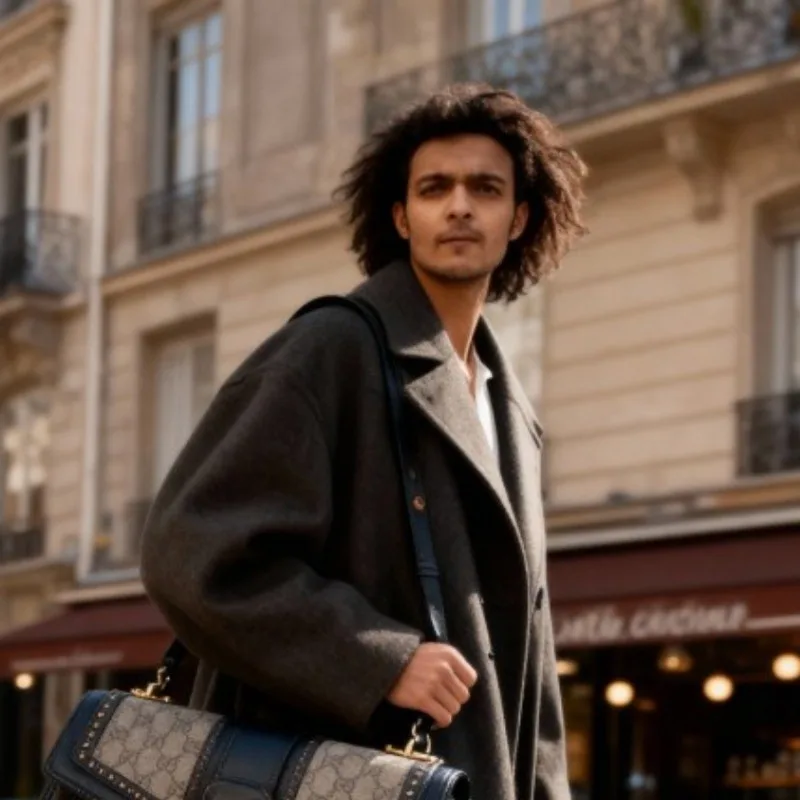
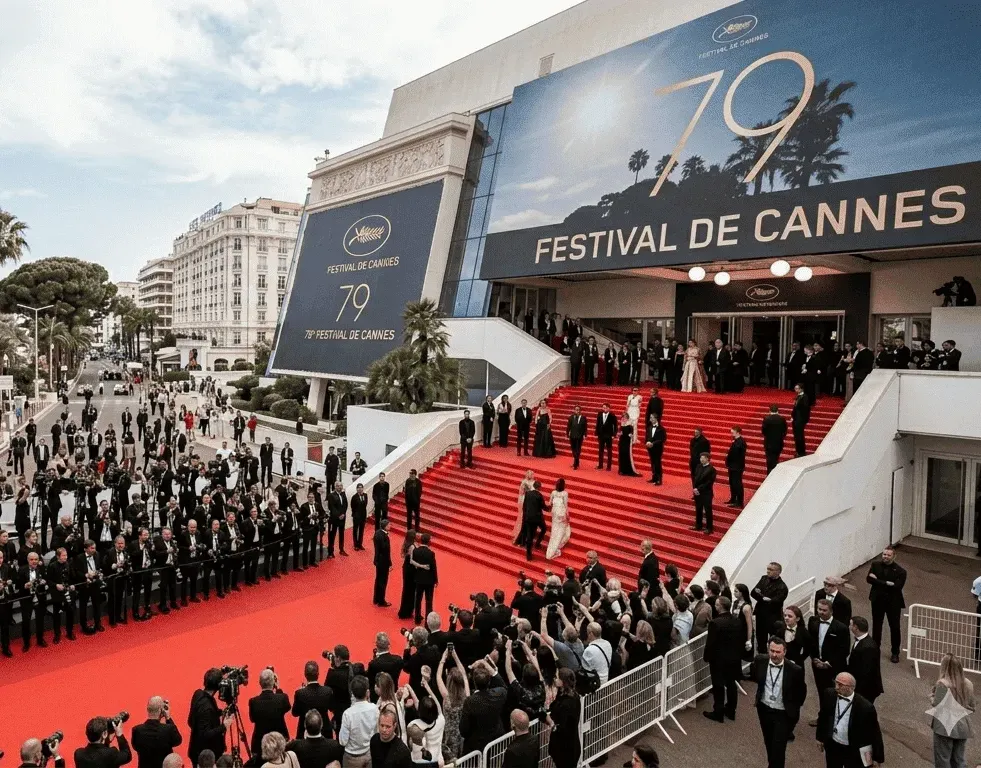
The Cannes Film Festival wants you to know it did not show this movie.
That is an unusual thing for a festival to put in writing. But in late May 2026, after a wave of headlines — including, embarrassingly, one in the Wall Street Journal — announced that an entirely AI-generated feature called Hell Grind had premiered at Cannes, the festival's press office issued a flat denial. The film, a spokesperson confirmed after reporters failed to find it anywhere on the official schedule, was not screened as part of the official Festival de Cannes program. It had merely appeared, as other outlets reported, at an industry event staged by third parties in the same city, during the same weeks.
Translation: a company rented a room near the world's most prestigious film festival, screened its movie, and a good chunk of the press wrote it up as if the festival had opened its doors. By the time the correction caught up, the trailer had already racked up tens of thousands of views on the film site JoBlo alone — where the verdict from those 42,000-odd viewers was close to unanimous, and close to merciless. It looked, they said, like exactly what it was.
So let's get the two halves of this story straight, because nearly everyone telling it has mashed them into one. Hell Grind is a real technical achievement and a real piece of marketing dishonesty at the same time, and you don't have to choose between those facts. The pixels are genuinely impressive. The "Cannes premiere" was genuinely fake. Untangling the two is the only honest way to write about this film — so that's what we'll do.
What Is Hell Grind? The $500,000 AI Movie from Higgsfield AI
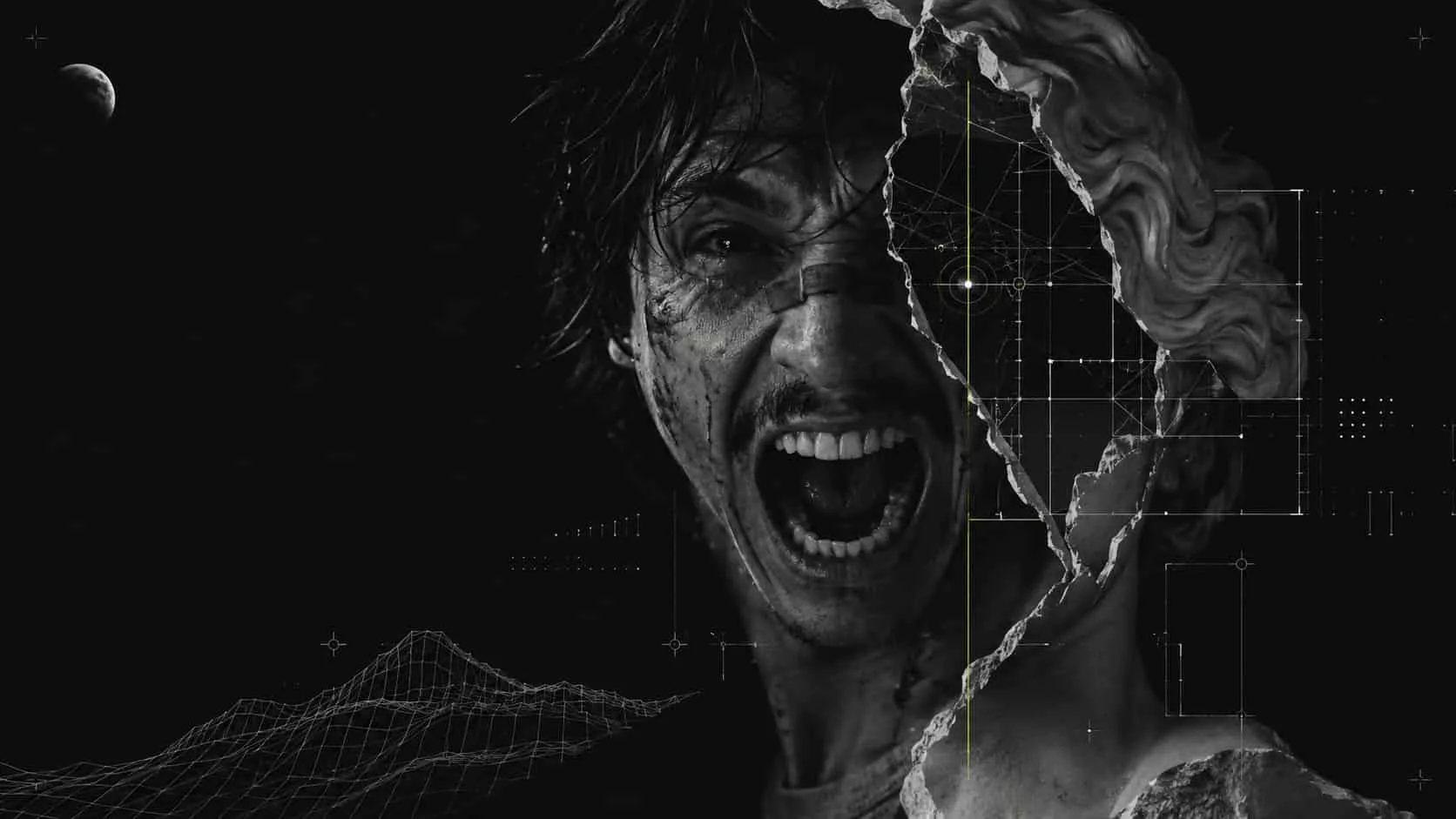
Strip the spin and the basics are these. Hell Grind runs 95 minutes, directed by Aitore Zholdaskali and co-written with Adilkhan Yerzhanov — a real filmmaker, twice selected for Cannes' official programme, whose credits include The Gentle Indifference of the World. The plot: four inseparable street thieves — Roco, Lulu, Jax and Rein — pull a heist that detonates when one of them trips an ancient artifact and drops Lulu through a portal into the underworld. The other three chase her across a Tibetan temple and feudal Japan to claw her back, while Roco slowly mutates into something less than human.
Every frame was generated. The pipeline leaned on Google's image models for the characters and ByteDance's Seedance for the motion, all orchestrated through Higgsfield, the San Francisco platform that built the film as a flex. A crew of fifteen — directors, cinematographers, editors — steered roughly thirty AI agents over fourteen days. The bill came to under $500,000, about $400,000 of it raw compute. Higgsfield's pitch is that the same film made the traditional way would cost $50 million.
Hold onto that $50 million. It's doing a lot of quiet work, and we'll come back to it.
Did Hell Grind Really Premiere at Cannes?
Here is the trick, and it rewards a close look because it was executed so cleanly.
There are two Cannes. One is the Festival de Cannes — juried, curated, the red carpet and the Palme d'Or, an institution that decides what screens and what doesn't, and which has explicitly refused to admit wholesale AI-generated features into its official selection. The other is the Marché du Film and the swarm of private industry events orbiting it: a commercial bazaar where anyone with a budget can book a screening in the city of Cannes during festival weeks. The first is an honor bestowed. The second is a room you rent.
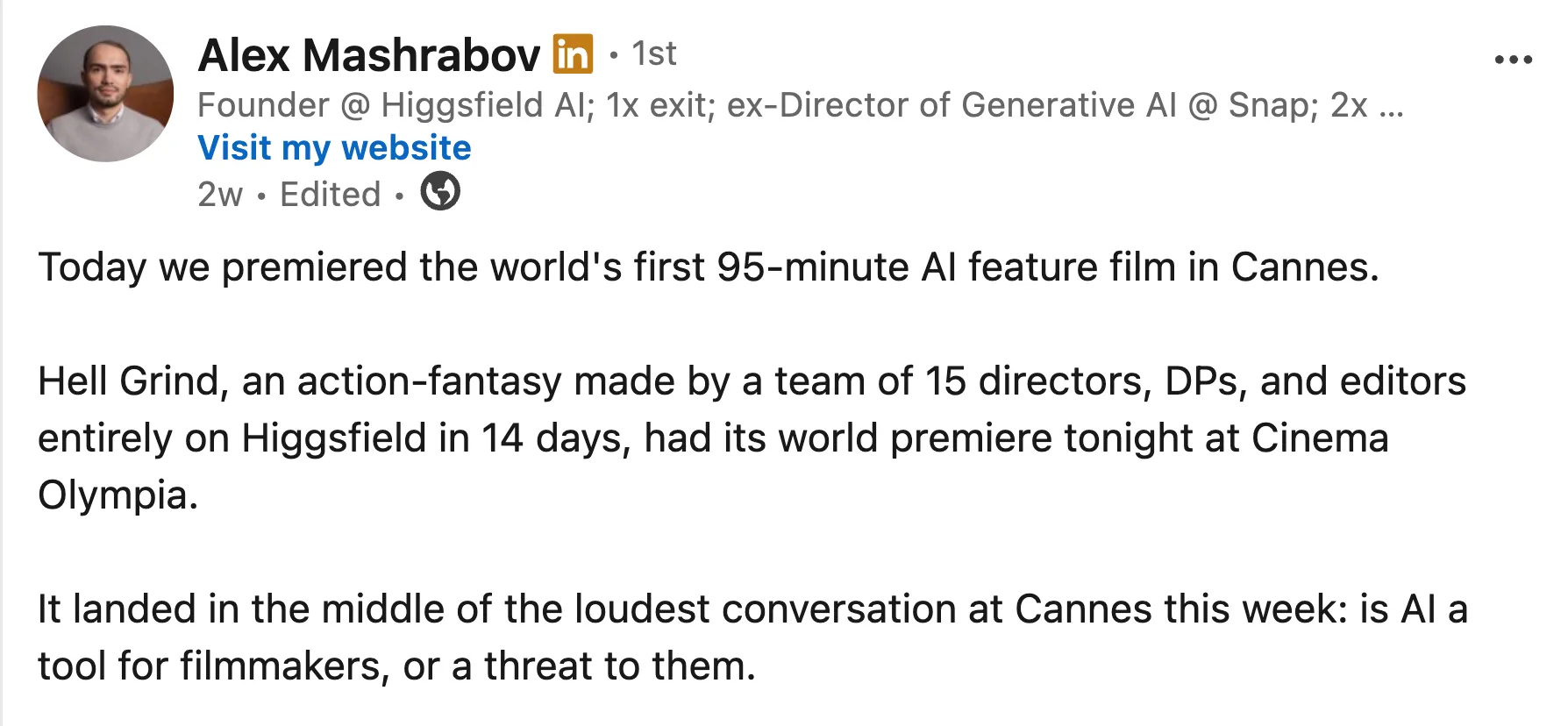
Hell Grind lived entirely in that second world — a private preview on May 16, a market screening on May 21, hosted with an outfit called Goldfinch. The festival jury never saw it, never selected it, and by its own rules could not have. Yet Higgsfield's founder, Alex Mashrabov, announced the company had "just premiered in Cannes," and trailers went out stamped "now screening at the Cannes Film Festival." When the festival pushed back, Higgsfield didn't retract — it doubled down, recasting the market as an "accredited component of the Cannes ecosystem." Which is the sort of phrase you reach for when the plain word, festival, is the one you're no longer allowed to use.
"A jury at the world's most important film festival deemed our AI movie worthy" and "we paid to screen our AI movie in the same town that week" are different universes of claim."
The distinction is not trivia. Higgsfield kept grabbing for the first while only owning the second. And it fits a pattern becoming familiar in AI marketing: earlier in 2026, a clip of Tom Cruise and Brad Pitt brawling on a rooftop went viral as proof Hollywood was finished, before turning out to be an AI reskin of real footage of real performers. The capability was real; the demonstration was theater. Hell Grind runs the same play — attach prestige the work hadn't earned through the process that prestige is supposed to represent.
Credit where due: not everyone swallowed it. The film critic Jordan Ruimy, at World of Reel, flagged within a day that the Cannes framing was false — a third-party event in the city, not the festival. But the formal bust came from Futurism, which went looking for Hell Grind on the official schedule, couldn't find it, contacted the festival directly, and got the spokesperson's on-record denial — getting right in an afternoon what newsrooms with real fact-checking budgets fumbled. The lesson underneath is its own small story. When a company hands the press a tidy narrative and a dramatic number, a startling amount of the press simply retypes it. Read enough Hell Grind coverage and you'll spot the same vivid scene-setting and the same unexamined "$50 million" migrating from outlet to outlet, serial numbers barely filed off. The premiere myth spread because the machinery to wave it through was already humming.
Is Hell Grind Actually the First AI Feature Film?
There's a second claim worth puncturing on its own, separate from the Cannes one: "the world's first ever AI feature film."
It isn't, or at least it's nowhere near as clean as the billing suggests. Several films could stake the same claim, and Cannes' own market that year featured other AI-built features — including two sci-fi projects, Hyperia and b, from a different filmmaking camp entirely. Even Hell Grind's own production notes give the game away: the film is described in terms of its "first 25-minute episode," language that suggests episodic content stitched toward feature length rather than a movie conceived as one. "First" is the most load-bearing word in tech marketing and the least examined. Here it's less a fact than a flag planted in contested ground.
The Uncomfortable Truth: Hell Grind Is a Genuine Technical Leap
Now the turn — because a piece that only sneers would be as lazy as the coverage it's criticizing.
The single hardest thing in AI video is consistency: keeping a face the same face from shot to shot, keeping a body from melting at the edges, making motion that reads as motion rather than a fever dream. For two years that's been the tell — the thing that screamed generated within five seconds. Hell Grind mostly holds it together for 95 minutes, across hundreds of shots, and that is not nothing. Reviewers who went in hostile came out conceding the characters stayed coherent, that the children in particular were unsettlingly lifelike, that the movement had a fluidity older tools could not produce.
The most telling endorsement didn't come from the company. Chuck Russell — director of The Mask, Eraser, and A Nightmare on Elm Street 3 — turned up at the Cannes event after seeing early footage, careful to say he had nothing to do with making it: "an observer and now a fan." What struck him was that he responded to the characters at all; it was the first time, he said, that he'd found AI characters genuinely charming. That carries weight, because Russell has wagered on this now: he's launched his own venture, Neumorphic AI, and announced two AI-assisted features — Hyperia and b — to be made with Higgsfield, shooting live actors on LED stages inside AI-generated worlds.
"AI is a wild horse. It will run away with your story if you don't have discipline and learn how to use it properly. "
There's a sincerely moving case buried here too. Zholdaskali spent the better part of a decade trying to finance his first conventional feature; plenty of peers he started with never directed anything. To him this is the moment the laptop had in music — when making something stopped requiring permission and a vault of cash. If you've ever been priced out of your own ambition, that lands. This is the part of the AI story worth rooting for.
Why Hell Grind Falls Apart?
Here's where the wild horse bolts.
Nearly everyone who has watched Hell Grind agrees the story is incoherent — and the most damning confirmation comes from the people who built it. Mashrabov has been refreshingly blunt that the goal was never a good movie; it was to prove the pipeline could sustain a feature at all. An honest thing to say, and a strange thing to charge admission for. The film can summon a demon's face in eerie detail. It just has nothing for that demon to be.
That's the hollow at the center: every scrap of effort went into generating the images, almost none into giving anyone a reason to watch them. The barrier AI knocked flat — money — was never really what stood between most people and a good film. A story worth telling costs attention, not compute, and Hell Grind spent its attention on the wrong thing. The audience put it more sharply than any critic: the line echoing through the Reddit threads was that if it weren't AI, it would still be bad. That's the one verdict better models can't reverse. The next version will fix the flat voices and the stray glitches. It won't hand anyone a story they needed told.
The Slot Machine: How Hell Grind Was Really Made
To see why "feature film" is a generous label, look at how the thing was actually built.
To stop the characters from drifting, the team wrote prompts running thousands of words each, then generated and regenerated short clips until one came out clean enough to keep.
That was for the first 25-minute stretch alone. Mashrabov's own word for the experience was a slot machine: pull the lever, wait, and most of the time you get garbage. The human skill on display isn't authorship in any sense a novelist or cinematographer would recognize. It's taste at industrial volume — panning a river of near-misses for the occasional nugget.
Now bring back that $50 million. It's Higgsfield's own figure, repeated everywhere and checked by no one, and it's quietly rigged — and not only because an AI pipeline pays for no cast, no locations, no insurance, no crew of hundreds, no months of shooting days. It's rigged in a subtler way too: the eye-watering budgets that "comparable" films carry today are largely a post-2020 phenomenon, inflated by superstar salaries, sprawling effects houses, and marketing spends that can rival the production itself. A studio tentpole's "$200 million" isn't the cost of making a story; it's the cost of A-list fees, global ad buys, and the ticket you eventually pay at the box office to cover all of it. Comparing a compute bill to that and calling the difference "savings" measures two things that were never the same object — like pricing a photograph of a meal against the cost of running the restaurant, then billing the diners.
The comparison that should actually sting isn't to a bloated modern blockbuster. It's to what filmmakers have made for less than this film's half-million — no AI, and with everything Hell Grind lacks: a reason to care.
| Film | Approx. Budget | Achievements |
|---|---|---|
| Primer (2004) | ~$7,000 | Won Sundance's Grand Jury Prize; smarter than most blockbusters |
| Paranormal Activity (2007) | ~$15,000 | One of the most profitable films ever made |
| Krisha (2015) | ~$30,000 | Launched Trey Edward Shults; SXSW winner |
| Tangerine (2015) | ~$100,000 | Shot on three iPhones; a critical landmark |
| Open Water (2003) | ~$130,000 | Micro-budget thriller, wide theatrical hit |
| Once (2007) | ~€130,000 | Won the Academy Award for Best Original Song |
| Napoleon Dynamite (2004) | ~$400,000 | Sundance breakout, enduring cult classic |
Figures are widely reported estimates and vary by source — the point is the order of magnitude.
Hollywood's Civil War: What Cannes Really Revealed
Hell Grind didn't drop into a vacuum. It landed in the middle of an industry still raw from the nearly four-month SAG-AFTRA strike of 2023, fought in part over exactly this — machines trained to replace the people who make films. And Cannes 2026 turned into an open referendum on it.
The camps were stark. Demi Moore, a jury member that year, told a press conference that fighting AI was "a battle that we will lose," urging the industry to work with it instead — and was promptly accused online of surrendering cinema to Silicon Valley. Drive director Nicolas Winding Refn took the diplomat's line, comparing AI to a painter's brush: the tool is neutral, the artist decides. And Tilda Swinton planted the flag for the opposition in eight words.
"AI doesn't have a chance. Humans make cinema, right?"
That spectrum — surrender, negotiate, resist — is the real story Cannes told in 2026, and Hell Grind was its lightning rod precisely because it was so eager to be the future and so unable to prove the future was worth having.
What Higgsfield Is Really Selling
Remember that Hell Grind isn't really a movie for sale. It's a billboard.
Higgsfield, co-founded in 2023 by Mashrabov — formerly head of generative AI at Snap, which had bought his previous startup for $166 million — has become one of the fastest-scaling software companies of the decade, and the first Kazakhstani firm to reach unicorn status. An Accel-led round early in 2026 valued it north of $1.3 billion; the company has said its revenue run-rate doubled to $200 million within months. Most of that money comes not from cinema but from social-media marketers churning out ads — the unglamorous, enormous business the film exists to advertise to Hollywood.
Which reframes the whole stunt. Hell Grind was never trying to be Parasite. It was trying to convince studios and agencies that a feature-scale pipeline now exists — and on that narrow, commercial measure, it largely worked. The dishonesty was never in the images. It was in the wrapping: dressing a trade-show demo as a Cannes coronation, because "premiered at Cannes" sells the pipeline harder than "screened at a rented venue near Cannes."
"The honest ledger. The technology is real, improving fast, and already useful for what it's actually good at — ads, pre-visualization, fixing a botched shot without a reshoot, handing a broke twenty-three-year-old in Almaty or Lagos the tools that used to cost a studio. The unsolved problem was never the rendering. It's the meaning. And meaning is still, stubbornly, a human job."
Hell Grind proved a machine can now generate a watchable action sequence. It also proved that's the easy part. The hard part — the only part that was ever hard — is making someone care. No one has automated that yet. The question for the next eighteen months isn't whether AI can fake a movie. It plainly can. It's whether anyone will use it to make one worth defending, instead of one merely worth announcing.
 Trending
The Side Hustle Summit Is a $15 Funnel Into Higgsfield
There's an old rule of the internet: if you're not paying for the product, you are the product. The Iman Gadzhi and Russell Brunson "Side Hustle Summit" was free. A million hopeful beginners were the inventory, and Higgsfield, a $5.4-billion AI company racing to feed its own valuation, was the buyer. As we write this, Higgsfield is down.
Kamran Arshad Monetization
How to Make Money With a Faceless AI Channel
A hands-on guide on how to make money with AI faceless channels, the tools required to getting started, and all the monetization methods.
Kamran Arshad8 min.webp) AI Faceless Channels
AI Faceless Channels12 Best Faceless AI Channel Ideas That Actually Make Money
Twelve faceless AI channel ideas with the money engine spelled out for each, real earning examples, and five videos to post for every one.
Kamran Arshad13 min